
Wholesale inflation in the country rose for the fourth consecutive month in June at 3.36 per cent on account of rise in prices of food articles, especially vegetables and manufactured items. The wholesale price index (WPI) based inflation was 2.61 per cent in May. It was (-) 4.18 per cent in June 2023.

Retail inflation eased to an 11-month low of 4.83 per cent in April as prices of some kitchen items declined though overall food basket firmed up marginally, according to a government data released on Monday. The Consumer Price Index (CPI)-based retail inflation was 4.85 per cent in March. It was 4.7 per cent in April 2023.

The Reserve Bank on Thursday said that the overall stance of its monetary policy for this fiscal would continue to accord a high-priority to price and financial markets stability and well-anchored inflation expectations.

Moody's Ratings on Wednesday said India's economic growth will exceed 6.5 per cent in the next fiscal, up from 6.3 per cent this year, on higher government capex and consumption boost from tax cuts and interest rate reduction. Projecting a stable outlook for the banking sector, Moody's said although the operating environment of Indian banks will remain favourable in the next fiscal, their asset quality will deteriorate moderately after substantial improvements in recent years, with some stress in unsecured retail loans, microfinance loans and small business loans.

The 30-share S&P BSE Sensex ended up 130 points at 25,400 and the Nifty50 rose 46 points to close at 7,759.

Unless RBI temporarily relaxes the norms on recognising of bad loans, the pressure on this front could rise in the December quarter.

Sectoral performance was mixed with media and PSU banking stocks attracting buyer interest and healthcare, FMCG and metal stocks bearing the brunt of the bears

Reserve Bank is scheduled to announce its bi-monthly monetary policy on August 3.

Titan surged 2.98 per cent, followed by IndusInd Bank, ITC, JSW Steel, Infosys, Tech Mahindra, Tata Consultancy Services and Maruti. Hindustan Unilever, Asian Paints, Bharti Airtel and HDFC Bank were among the laggards.

A combination of farm loan debt waivers by state governments and the implementation of the pay commission award could entail some fiscal slippages and pose a risk to inflation

IT shares hold on to gains while power, metals lag.
Deputy governors Subir Gokarn, Usha Thorat and Shyamala Gopinath will get additional portfolios, which were until now under K C Chakrabarty, RBI said in a statement today. The central bank did not give any reason for the reshuffle and said the changes will be effective tomorrow.
Indian capital markets joined the global sell-off sparked by China growth concerns

Policy rates have been reduced substantially in 2015.
.jpg)
Stating that there are strong inter-linkages between banks, NBFCs and other deposit-taking entities, he said for monetary policy to be effective and financial markets to remain stable, they should be regulated by the central bank.
Balance is needed in selecting members for the proposed monetary policy committee, says Abheek Barua.

Industrial countries cannot at this point wash their hands off developing economises and say we will do what we need to, and you do the adjustment you need to, says RBI Governor.

With inflation remaining high, the Reserve Bank on Monday indicated that it may go for another round of interest rate hike on Tuesday even though the step may impact the economic growth.

The Reserve Bank on Friday said it will soon commence the pilot launch of e-rupee for specific use cases with a view to bolstering India's digital economy, making payment systems more efficient, and checking money laundering. In a concept note on Central Bank Digital Currency, the RBI said CBDC is aimed to complement, rather than replace, current forms of money and is envisaged to provide an additional payment avenue to users, not to replace the existing payment systems. "Supported by state-of-the-art payment systems of India that are affordable, accessible, convenient, efficient, safe and secure, the Digital Rupee (e?) system will further bolster India's digital economy, make the monetary and payment systems more efficient and contribute to furthering financial inclusion," the paper said.

Unhedged exposure of the corporate poses a risk and overall percentage of hedging remains low.

The rupee has remained largely stable against the US greenback in the current calendar year (CY 2024), depreciating by just 0.59 per cent so far. However, it has considerably weakened against the euro and pound. The local currency has depreciated by 1.6 per cent against the euro and 5.6 per cent against the pound, as both currencies strengthened against the dollar during this period.
The status quo decision came as a breather as only last week the RBI had pulled up banks for not helping it in monetary policy transmission.


As per the RBI Act, the central bank should have four deputy governors - two from within the ranks and one commercial banker and the fourth one an economist to head the monetary policy department.

The RBI added roughly 3 tonnes in 2025, taking its gold reserves to 879 tonnes as of January 31, 2025.

Concerned over elevated inflation, Reserve Bank of India on Friday decided to leave the benchmark interest rate unchanged at 4 per cent but maintained an accommodative stance, implying more rate cuts in the future if need arises to support the economy hit by the Covid-19 pandemic.

The MPC states that the 4 external members will have a tenure of four years each.

Reserve Bank Governor Shaktikanta Das on Wednesday said in the wake of appreciating US dollar, the movement of rupee has remained least disruptive as compared to its peers, and the size of foreign exchange reserve is comfortable. On a financial year basis (from April to October 2022), the rupee has appreciated by 3.2 per cent in real terms, even as several major currencies have depreciated, he said while announcing the latest set of bi-monthly monetary policy. "The story of the rupee has been one of India's resilience and stability," the Governor said while pointing out that the appreciation of the US dollar this year, which precipitated large-scale depreciation of all major global currencies including the Indian rupee, has drawn wide attention.

Former Reserve Bank of India Governor Duvvuri Subbarao has said the central bank could lose control over money supply and inflation management if cryptocurrency is allowed in the country. Speaking at a webinar organised by the National Stock Exchange (NSE) and New York University (NYU) Stern School of Business, Rao also said India's case for issuing a central bank digital currency (CBDC) may not be strong as there are capital controls. "Crypto is backed by algorithms and there is fear that the central bank might lose control over money supply and inflation management.
Describing the annual monetary policy announced by RBI Governor D Subbarao as a progressive one, Ernst & Young India's Ashvin Parekh said, "We have almost reached a point where inflation has become unmanageable and RBI has clearly indicated that bringing down inflation to a comfortable level is its top priority."
Reserve Bank of India Governor Raghuram Rajan said, in an election year, it is better to be ready for any eventuality.

Rajan had cautioned against any deviation from the fiscal discipline path.
The Reserve Bank's annual monetary policy will moderate inflation without hurting growth, while providing relief to small housing loan borrowers, Finance Minister P Chidambaram said on Tuesday.

Governor Raghuram Rajan lowered the benchmark repurchase rate to 7.75 per cent from 8 per cent, the first reduction since May 2013.
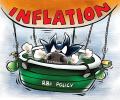
The Reserve Bank of India on Friday raised the retail inflation forecast for 2021-22 to 5.7 per cent due to supply side constraints, high crude oil and raw materials cost. The RBI in June had pegged the retail inflation estimate at 5.1 per cent for the current financial year. The RBI has the mandate to keep inflation in a band of 2-4 per cent, with a tolerance level of 2 per cent on either side.

The central bank can directly print money and finance the government, but it should avoid doing so unless there is absolutely no alternative, former RBI governor D Subbarao on Wednesday said while pointing out that India is 'nowhere' near such a scenario. In an interview with PTI, Subbarao suggested that to deal with the second wave of COVID-19 induced slowdown in the economy, the government can consider Covid bonds as an option to raise borrowing, not in addition to budgeted borrowing, but as a part of that.

The Reserve Bank may be hitting the end of its tolerance for high inflation and will most likely hike interest rates in the first half of 2022, analysts said on Friday. The central bank will also start rolling back its accommodative policies which have led to easy liquidity conditions, they said. The view from analysts came even as inflation cooled down to 5.6 per cent for July, after two months of breaching the upper end of the RBI's tolerance band of 6 per cent.

The Reserve Bank of India's interest rate decision, domestic macroeconomic data and global trends will dictate terms in the equity markets this week, analysts said. Trading activity of Foreign Portfolio Investors (FPIs) will also influence markets, they added. "The Indian market will be closely monitoring the Reserve Bank of India's Monetary Policy Committee (MPC) meeting scheduled for June 6-8, 2023. Aside from that, market participants will be keeping an eye on the progress of monsoon," said Pravesh Gour, Senior Technical Analyst, Swastika Investmart Ltd.

Bajaj Finance was the top gainer in the Sensex pack, rising around 4 per cent, followed by Maruti, SBI, Bajaj Finserv, Sun Pharma and Asian Paints. NSE Nifty rallied 293.05 points to 17,469.75.
The central bank will appear vacuous if it holds fire next week following its ultra hawkish guidance at the last monetary policy review.
